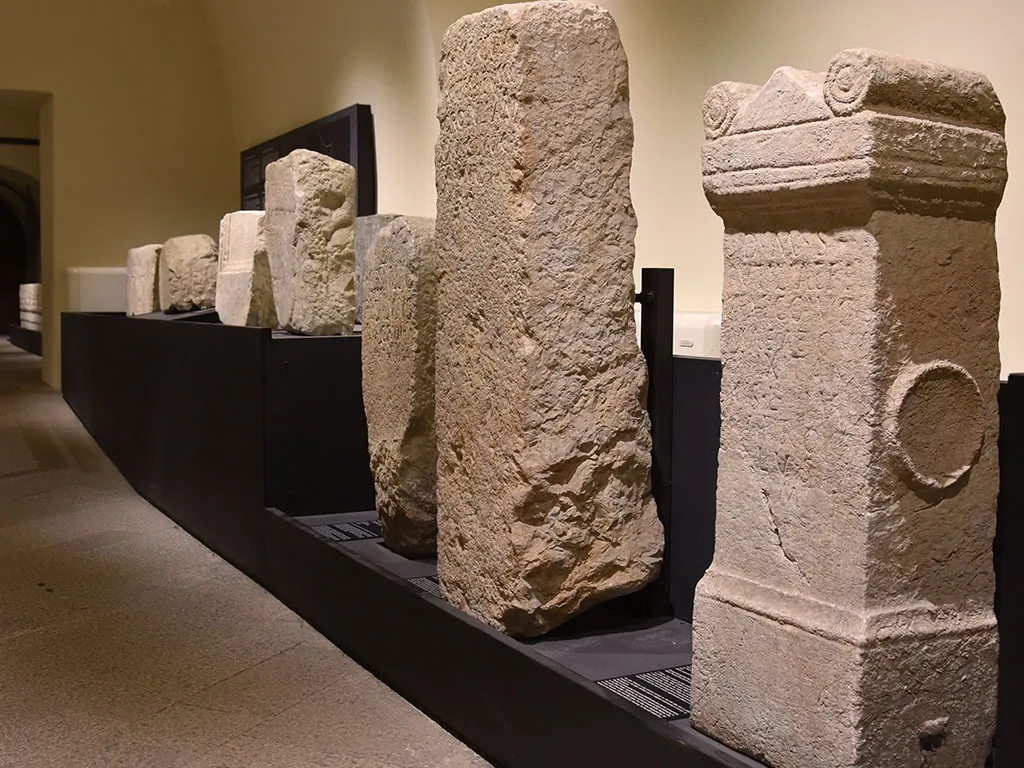
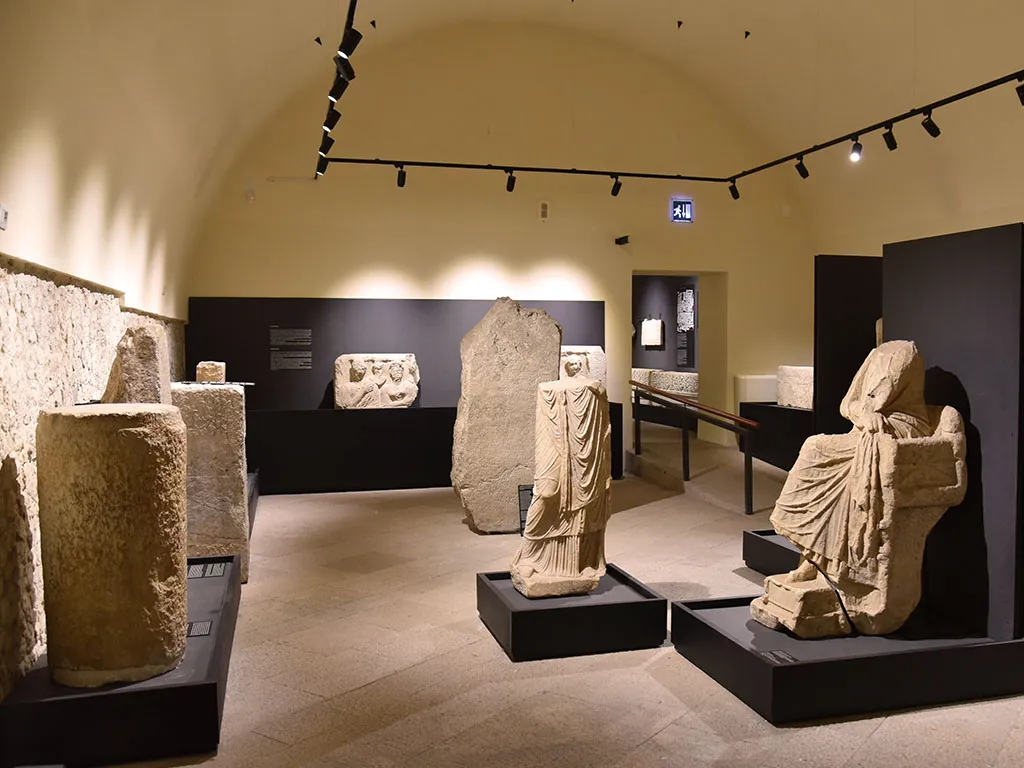
Room 1 is dedicated to the Via Appia, one of the most important arteries of the Roman world, known since antiquity as the Regina Viarum — the Queen of Roads. Built in the 4th century BC, the road connected Rome with southern Italy and for centuries served as a fundamental axis for travel, commerce and communication. Its route also passed through the territory of Fondi, contributing to the city’s economic development and growth.
The room displays artefacts recovered along the ancient road and in the surrounding areas. Among them are inscriptions, architectural elements and archaeological evidence documenting the presence of funerary monuments, structures and activities connected to the road. These materials help us understand the central role of the Via Appia in the life of the Fondi territory and its significance as a place of encounter, passage and memory.
The Via Appia:
Fondi, a Crossroads of the Empire
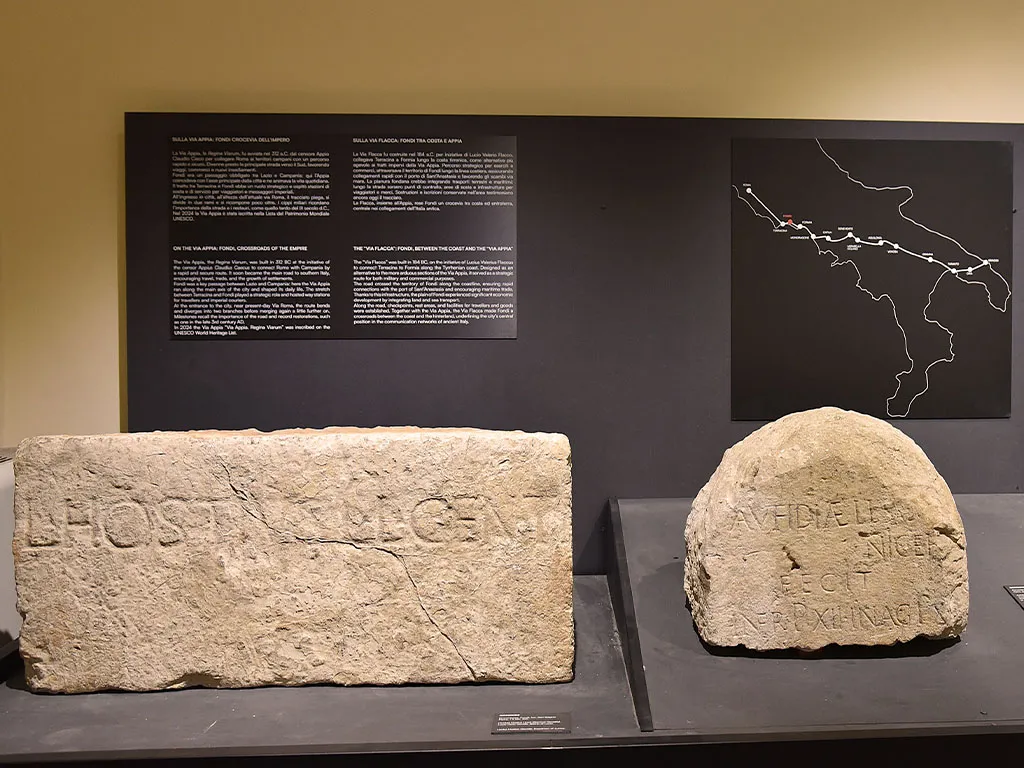
The Via Appia, the Regina Viarum, was built in 312 BC at the initiative of the censor Appius Claudius Caecus to connect Rome with the region of Campania by a rapid and secure route. It soon became the main road to southern Italy, encouraging travel, trade and new settlements. Fondi was a key passage between Lazio and Campania: here the Via Appia ran along the main axis of the city and shaped its daily life.
The stretch between Terracina and Fondi played a strategic role and hosted way stations for travellers and imperial couriers. At the entrance to the city, near present-day Via Roma, the route bends and diverges into two branches before merging again a little further on. Milestones recall the importance of the road and record restorations, such as one dating to the late 3rd century AD and in 2024 the Via Appia was inscribed on the UNESCO World Heritage List.
The Via Flacca: Fondi between Coast and Appia
The Via Flacca was built in 184 BC on the initiative of Lucius Valerius Flaccus to connect Terracina to Formia along the Tyrrhenian coast, designed as an alternative to the more arduous sections of the Via Appia. It served as a strategic route for both military and commercial purposes and crossed the territory of Fondi along the coastline, ensuring rapid connections with the port of Sant’Anastasia and encouraging maritime trade.
Thanks to this infrastructure, the plain of Fondi experienced significant economic development by integrating land and sea transport. Along the road, checkpoints, rest areas and facilities for travellers and goods were established. Retaining walls and inscriptions preserved in the area still attest to the route today. Together with the Via Appia, the Via Flacca made Fondi a crossroads between the coast and the hinterland, central to the communication networks of ancient Italy.
The Inscriptions
Inscriptions are the “voices” through which the Fondi of two thousand years ago still speaks today. From public texts, we know that the city carefully managed its territory: one inscription records the drainage of marshlands and the restoration of a road often flooded by water; another one commemorates the rebuilding of the walls and the city gates. Other epigraphs mention the macellum, the main food market, and the Via Appia with its milestones, which place Fondi within the Empire’s network of communications.
Honorary inscriptions reflect the prestige of local magistrates, such as L. Runtius Gemellus, remembered for the games held in the amphitheatre. Funerary epitaphs open a window onto local families: notables, freedmen, soldiers and foreigners from the Greek East. Through these carved stones we recognise a living community, attentive to rights, boundaries and memory — whose aspirations and needs are not so different from our own.
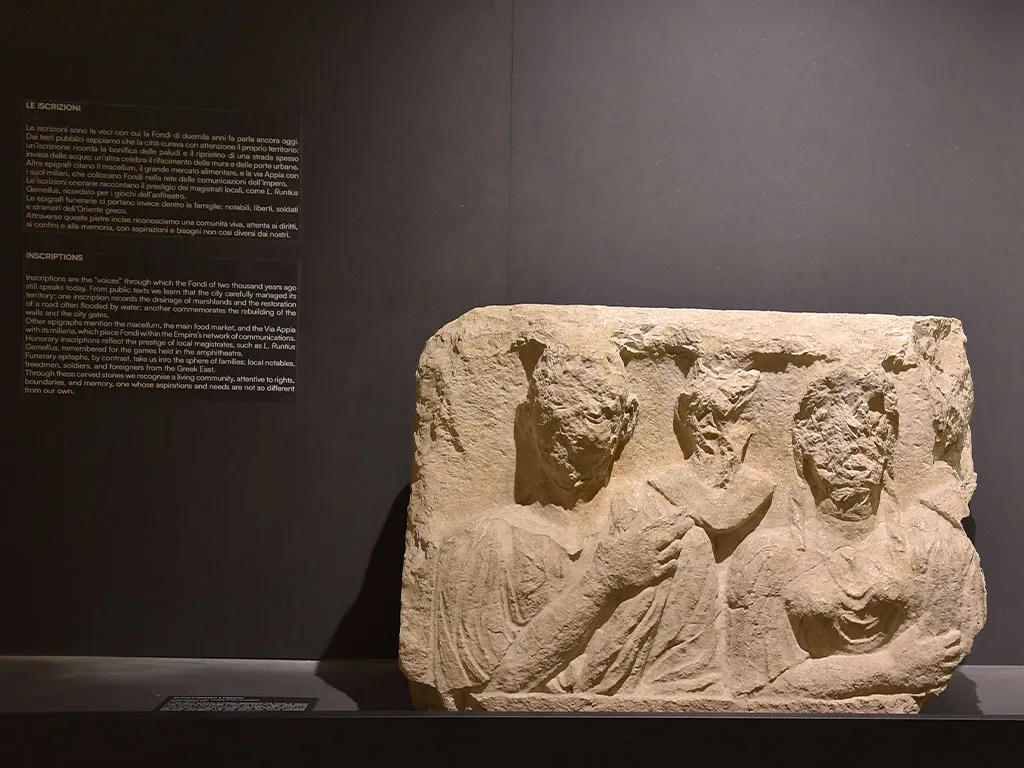
Exhibits on display
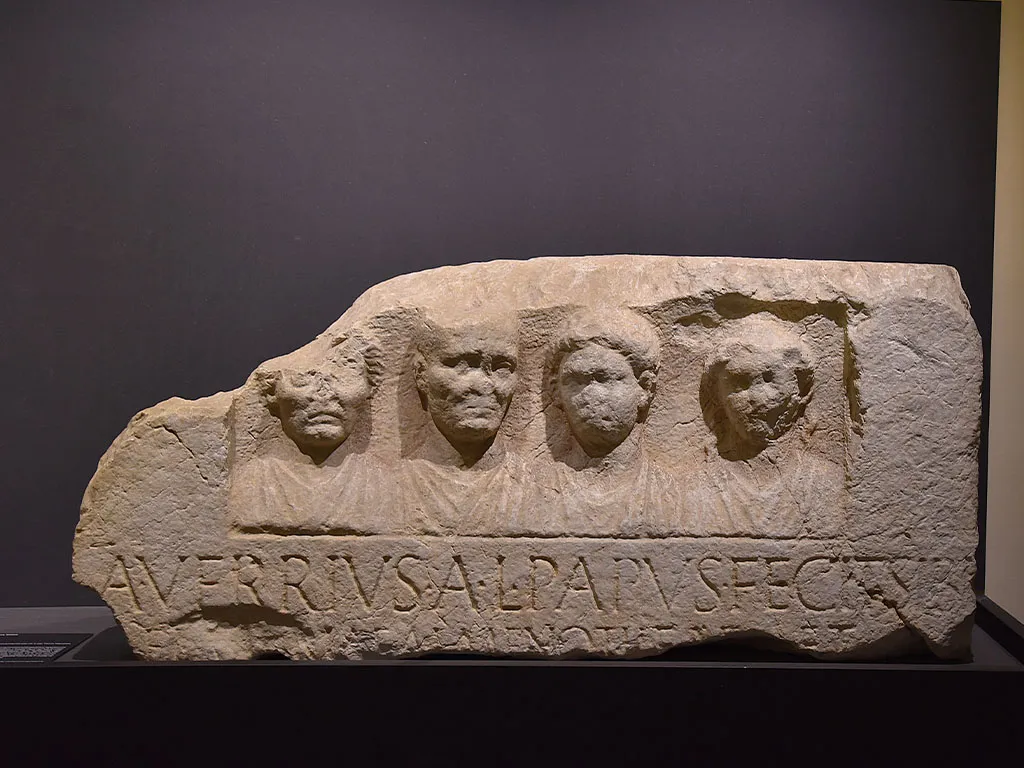
A Portrait of Fondi in Ancient Rome
Unknown provenance — Marble — First half of the 1st century AD
A(ulus) Verrius A(uli) l(ibertus) Papus fecit sibi
et V[er]riae A(uli) l(ibertae) Menotheae et [---]
Aulus Verrius Papus, freedman of Aulus, made (this monument) for himself and for Verria Menothea, freedwoman of Aulus, and for [---]
This window-type funerary relief shows four busts within a rectangular niche, depicting a family of the city: a man, a woman and two children. The inscription names the family Papus, of the gens Verria, and their memory survives in the local place name Cesa del Papa in the hamlet of Cocuruzzo.
The female figures wear the hairstyle known as “alla Ottavia”, named after Octavia Minor, the sister of Augustus — with a central parting, hair gathered at the nape and soft waves framing the face — a mark of style and status between the late Republican period and the early decades of the Empire. The relief is not only a funerary work of art but a living fragment of the community of Fondi in antiquity, capturing dress, the sober elegance of the élites and the bonds between parents and children.
Public Games and the Amphitheatre of Fondi
Unknown provenance — Limestone — Late 1st century BC – 1st century AD
L(ucio) Runtio, L(ucii) f(ilio), Aem(ilia tribu)
Gemello
Aedili iterum quinq(uennali),
quod curam muner(is)
publice splendide
administaverit,
Fundani, aere conlato.
L(oc) d(ato) d(ecreto) d(ecurionum)
This inscription is an early piece of evidence for the amphitheatre of Fondi; it commemorates L. Runtius Gemellus, a local magistrate, who “managed the public spectacle magnificently” (curam muneris publici splendide administravit). Gladiatorial contests and other performances of this kind took place in the amphitheatre.
In another inscription, now lost, M. Ulpius Natalis “for the staging of a public munus” had a statue erected at his own expense — a sign of the prestige attached to the organisation of the games. In the Middle Ages, a document of 1071 mentions a church of Santa Maria “situated next to the amphitheatre of the city of Fondi”; the same area is named in a deed of sale of 1076 as Conca Rotunda. Excavations in Via Mola della Corte have uncovered sections of the outer ring and the internal walls that supported the tiers of seating, confirming the elliptical structure of the building.